Ferrari 296 Battery Best Practices
One engineer’s research and conclusions after reading all the conflicting information out there

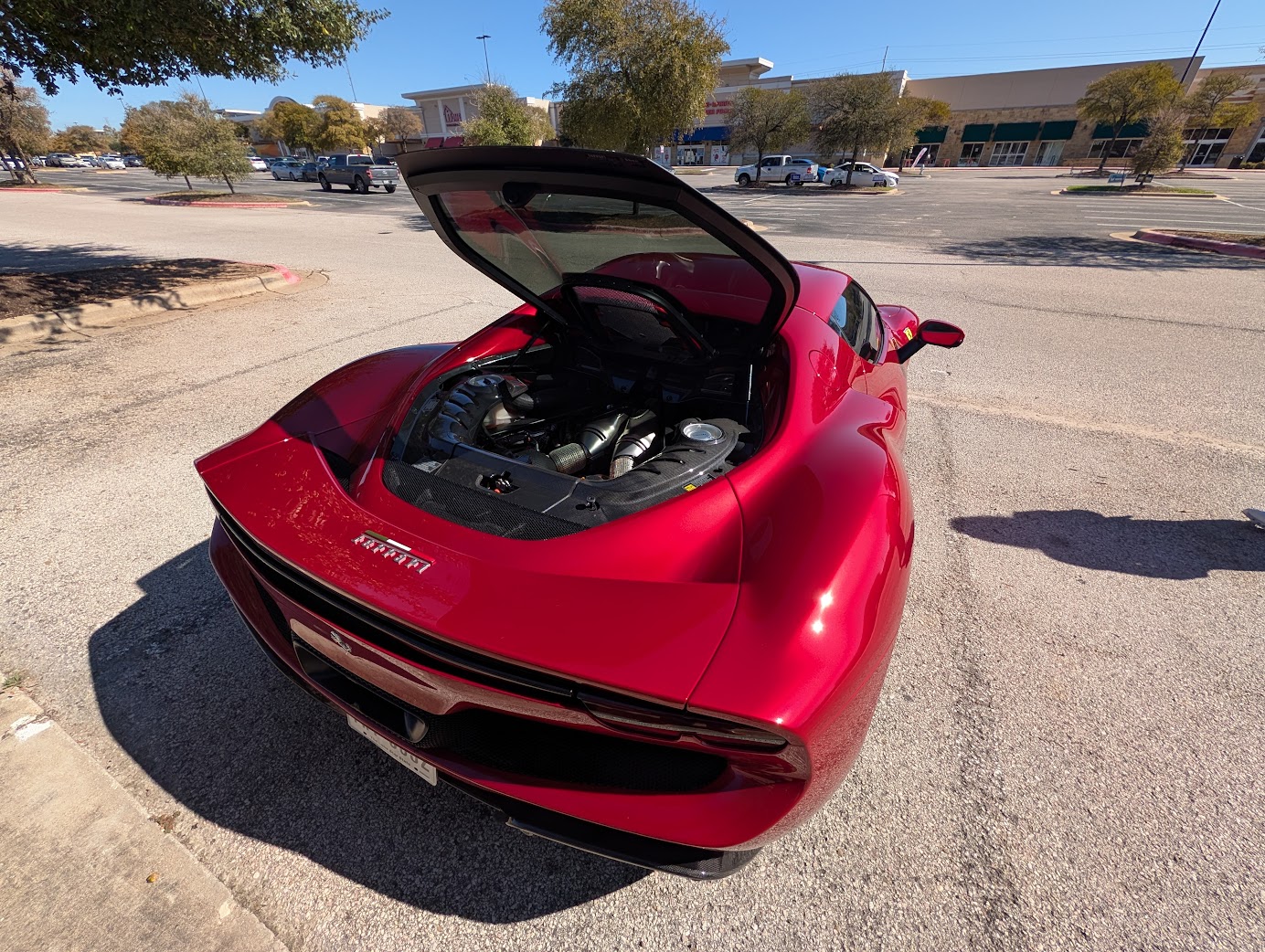
Setup: 2024 296 GTB, AGM 12V battery, software from June 2026, charging at 110V/12A
- The car has two batteries, a 12V battery that is either lithium-ion or lead acid AGM. Mine is lead acid AGM, so my advice is purely based on that. The second battery is the expensive 7.45kWh high voltage battery made by SK On.
- Keeping the 296 plugged in all the time is going to be the least hassle day to day. But your battery won’t last as long. That’s a fair tradeoff for many. I’m an optimizing engineer, that’s all.
Should you keep a Ferrari 296 plugged in?
- Plugging in all the time is not optimal for the high voltage battery. Never plugging in is not optimal for the low voltage battery.
- Next drive in a month or longer? Put the car in long term parking mode and plug it in. After a while the high voltage battery will drop down to a more reasonable storage level than 100%.
- Next drive in a week? Use performance mode, which will try and keep the battery around 50% as you drive, or a combination of modes so you arrive home around 50%. Then plug the car in for an hour before your next drive so the low voltage battery is charged to 100%.
- Next drive longer than a week but less than a month? You are in no man’s land. I lean towards leave the car unplugged for 10 days, then plug it in for an hour to charge the low voltage battery. Then repeat until you are ready to drive. Ideally, you take it around the block in eDrive mode to burn down the high voltage battery if it creeps up above 90%.
Why the two batteries conflict
- The HVB (high voltage battery) is going to be happiest stored at 50%
- The LVB (low voltage battery, 12V battery) is going to be happiest stored at 100%
- As of now, Ferrari gives us no way to set a max HVB charge level, which creates a natural tension between the two batteries. You can’t keep both happy. Your choices are having the HVB at 100% for weeks when you know you won’t drive. Or leaving your LVB stored at low charge and risking bricking the car.
- To me, the HVB is worth protecting, even at the risk of damaging the $600 12V battery. The high voltage battery is currently listed at $13,000 USD on some spare parts sites. Not to mention the high voltage battery requires disconnecting some coolant lines and taking the seats out of the car.
Research Notes
- Use long term parking mode, there is no real downside I’ve found other than the app doesn’t update often when parked.
- I use a Faraday cage box to ensure my key doesn’t keep my 296 awake. It is also cool to hear the car lock when you drop the key into the box.
- When not plugged in, the car charges the 12V battery with short pulses from the HVB. It never gets the AGM battery charged to 100%, which is suboptimal. I’ve only seen these pulses after a drive but haven’t gathered enough information yet to know if it will eventually charge the LVB as it drains.
- While plugged in, the car charges the 12V battery all the way to 100%, and does this quickly (1 hour)
- I used my multimeter to show that the OBD2 reader and the Ferrari app don’t give you the actual voltage of the 12V battery. The Ferrari app usually shows 11.8V, 12.8V or 13.9V in my experience.
- The 12V battery is used to run everything up until the moment you “start” the car, even if that start is EV mode.
- I have a software update as of June 2026, so all my experiences rely on that
- I have a 2024 car with an AGM battery, I can’t reliably speak for the 12V lithium-ion battery owners, but my guess is these principles still apply
- Lithium-ion batteries don’t like to be stored at 100%
- The 296 charges to 100% every time you plug it in, even in long term parking mode, which sucks. Yes, 100% is probably not the full 100%, but we know for certain it is greater than 80%.
- Interesting, immediately after turning the car off from eDrive, the battery read 14.5V. Not sure what’s going on there. It might be a good hack to burn off HVB when your LVB needs a charge. Start in eDrive mode and then immediately stop. That might charge the 12V battery.
- Heat causes havoc, avoid high charge levels and hot garages. While the car can cool the battery pack, it won’t cool it just because you have the car plugged in. After reaching 100% the car will go to sleep and stop cooling the battery.
- When you hit the start button the first time, let everything come up and settle before starting the car. This lowers the load on the 12V battery and may help with spurious errors. (was told this, seems to work for me anecdotally)
- I would avoid using Qualifying mode because you want to charge the battery to 100%. Qualifying mode is great fun when you really want every bit of performance, but the car charges the battery fast in qualifying mode, which will generate more wear than a slow charger at home.
- Temperature control is key here. The best way to harm the battery is to charge it to 100% and store it at high temperatures.
- Early cars seemed to have several software issues that mine doesn’t. For cars without the latest software update, keeping it plugged in makes sense
- The car always pulls 12 amps at 110V the whole time, except for the final minute of charging where it ramps down 12A, 8A, 7A, 6A, 4A, 0A
- During one charge I saw 36 extra minutes of charging past "100%" in the Ferrari app before the ramp down. However, this may be normal, I don’t have a sample of the charge not going over the 100% in the app yet.
- Performance mode is probably better because it limits EV discharge/cycling compared with hybrid mode, but I’m certainly using hybrid in start/stop traffic.
- In one test, I drove the car in eDrive until the engine kicked on. I then parked it. Car said 0% charge, the app said 4% charge. I plugged it in. After 6.55kWh from the wall, the app said 100% charged. However, charging didn’t stop until 1 hour and 2 minutes later, showing a total of 7.85kWh pulled from the wall, when the HVB is only 7.45kWh in total. Importantly, for the entire time the car pulled 12A and then ramped down quickly over a minute at the end. At 95% charge efficiency, we charged the whole high voltage battery, and none is locked, which is very unlikely. This charge was done in an 80-degree A/C’d garage FWIW. —- so what charge efficiency are we going to guess at? At 80%, we put in 6.28kWh. At 90% we put in 7.06kWh. At 75% we put in 5.89kWh. At 85% we put in 6.67kWh. Since the reported buffer size is 20% on some European car sales sites, that would imply a charge efficiency of 76%. A little on the low side. Unfortunately, as cool as this test is, it still doesn’t tell us how the buffer is split top and bottom.
- Can we safely put a tender on the 12V battery? Seems like we can, if its voltage is below 14.5V that the car is using to charge. But I won’t be doing that until the hybrid warranty is out as the manual says not to. Once it is, I think arriving home with 50% and then putting the 12V on an AGM battery tender will be what I do.
- I still want to get data on the 12V battery charging when the car is not used for weeks. Unfortunately, I keep wanting to drive the car more than I want the data. So far, I think 11 days unplugged is the most I’ve done, and the HVB wasn’t used to charge the LVB